
Reciprocating compressor monitoring, validated on real customer faults.
TruPrognostics AI diagnoses process and mechanical faults across the reciprocating compressor train and forecasts remaining useful life where the data permits. Process-domain analytics from your historian on day one. Vibration-domain analytics where asset criticality earns them.
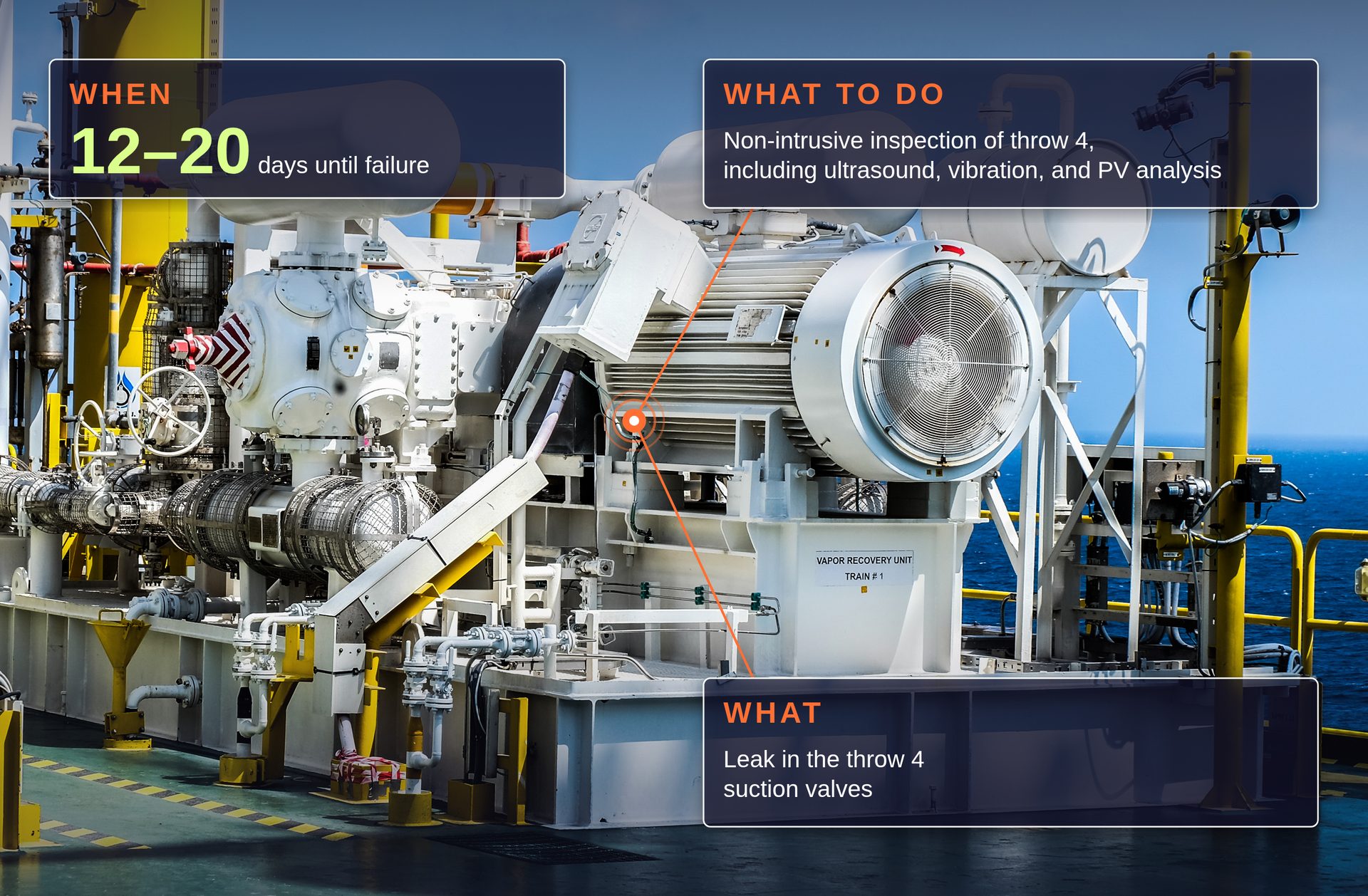
Four example high-impact fault modes from our recip coverage.
Tracked stage by stage, with RUL at every tier.
Cylinder efficiency degrades as valves leak, rings wear, and packing loses lubrication. TruPrognostics AI tracks per-stage performance against the operating points and produces a remaining useful life forecast at every tier.
Caught in the process domain before it surfaces in vibration.
Discharge temperature, interstage pressure, and flow signatures flag valve leakage well before frame vibration responds. Diagnosed at every tier and forecasted with RUL at Plus and Premium.
Diagnosed before catastrophic damage develops.
Loose pistons can cascade into severe damage if missed. TruPrognostics AI surfaces the developing signature in process and frame data, giving teams a planning window to intervene before it propagates.
Resolved across the full tier ladder, with RUL at Plus and Premium.
Anomalous frame behavior at Base sharpens to a specific bearing-wear diagnosis at Plus, with remaining useful life forecasts where high-frequency vibration is available.
Process data first. Vibration where it earns it.
Reciprocating compressors generate rich process-domain signatures. Pressures, temperatures, flows, and stage performance carry valve, piston, and process-side fault information that historian data already captures.
TruPrognostics AI starts there. Detected anomalies are diagnosed against a library of fault-specific models, each calibrated to the physics of how the failure mode shows up in process and frame variables. Where the data permits, the system produces a remaining useful life forecast.
Each diagnosis ships with a recommended action, drawn from OEM manuals, customer SOPs and FMECAs, and prior work-order history. Every recommendation cites the source it draws from. Engineers keep decision authority; TruPrognostics AI does the analytical heavy lifting.
For mechanical faults that surface earliest in waveform data, including bearing wear, oil whirl, crosshead looseness, and frame degradation, minimal high-frequency vibration sensing unlocks the frequency-domain analytics. Add a single sensor for substantial uplift, or full multi-modal sensing on the assets where forced-outage cost dominates.
See the full architecture →Validated against real reciprocating compressor faults.
True positive rate across reciprocating compressor fault modes, validated against customer-confirmed events at multiple operators and sites.
Coverage includes valve faults, mechanical faults on the running gear, and process-side degradation.
7,800 HP cylinder fault, identified 4 to 6 weeks before failure.
A major US upstream operator
TruPrognostics AI flagged a developing cylinder fault on a 7,800 HP reciprocating compressor and projected a failure window 4 to 6 weeks ahead. The failure occurred inside that window. Post-repair, asset health returned to 100% and the fault prognosis cleared.
4,000 HP loose piston, catastrophic failure avoided.
A US upstream operator with a critical reciprocating compressor train
An early loss-of-performance signal flagged a developing fault on a 4,000 HP unit. Frame vibration confirmed it three days later. Maintenance was scheduled 11 days out and revealed a loose third-stage piston. Less than one day of repair avoided several months of downtime.
Day-one value at Base. Mechanical precision at Plus and Premium.
PI / historian process data: suction and discharge pressures, interstage pressures, flow, RPM, cylinder discharge temperatures, lube oil and coolant temps, frame Vrms. Catches valve leaks, stage leakage, efficiency loss, strainer clogging, and process-side faults.
Adds high-frequency frame vibration or high-frequency cylinder pressure on top of the historian feed. Resolves bearing wear, oil whirl, crosshead bushing wear, and rod packing leakage to specific diagnoses, with RUL where data supports it.
Adds crosshead vibration, piston rod drop, and individual valve cap temperature. Enables RUL forecasts on rider band wear, individual valve leakage, and the most damaging mechanical fault paths.
See it on your own reciprocating compressors.
Send us a slice of your historian data. We return a working analysis on your assets in four weeks: written report, live walkthrough, and a platform with your data loaded.
Want to Read More?
PdM Insights
Detecting compressor valve failures before they drive unplanned downtime
PdM Insights
What Does Effective Reciprocating Compressor Monitoring Actually Require?
White Paper
Compressor Reliability Intelligence
Videos
TruPrognostics for Reciprocating Compressors
Articles
Article: Monitoring approach improves ability to predict, address compressor failures
Articles
Article: Predicting Reciprocating Compressor Valve Faults Using Digital Technology