
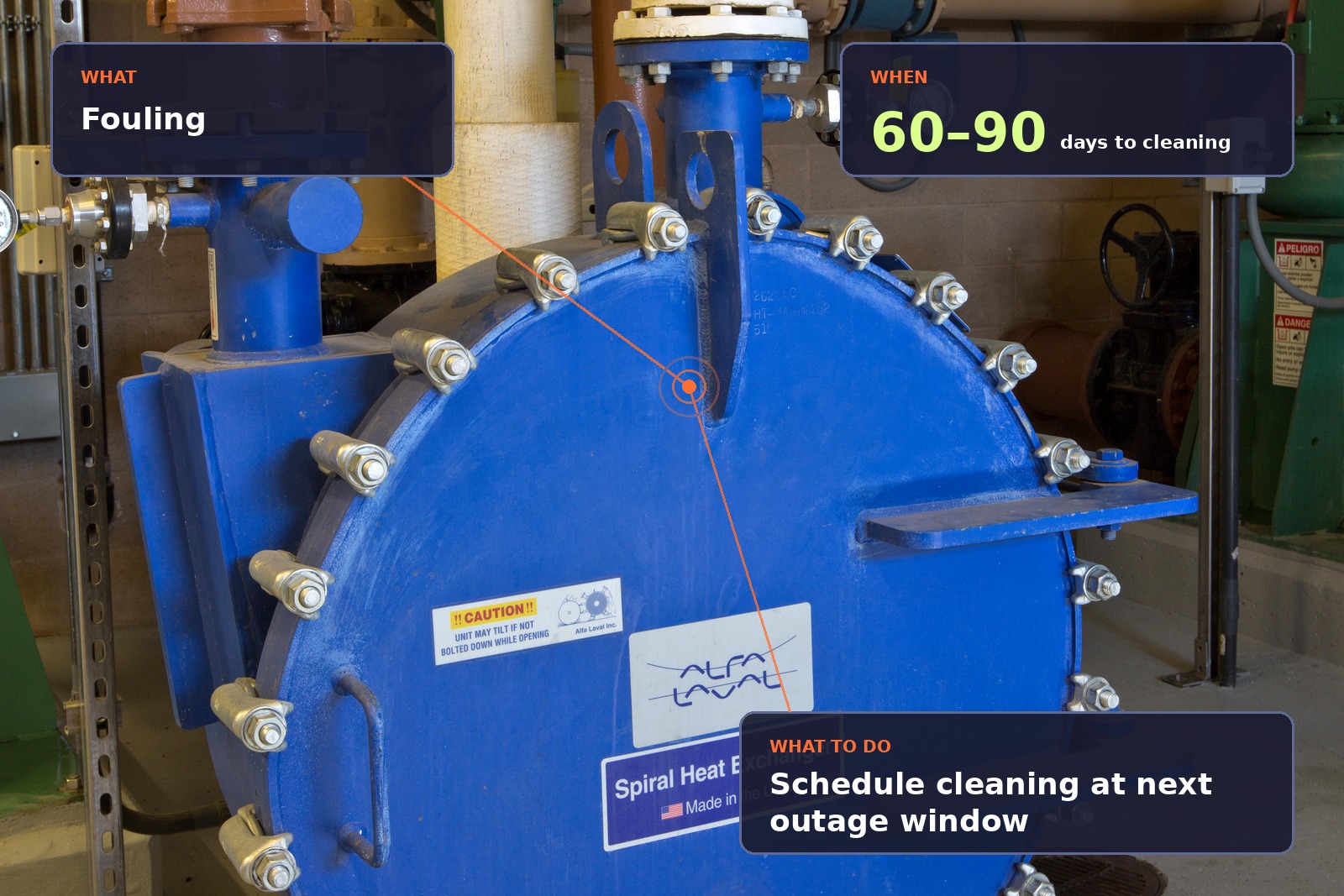
Heat exchanger monitoring with a recommended next step.
TruPrognostics AI diagnoses fouling, scaling, and heat-transfer degradation, predicts when cleaning is needed, and recommends a specific maintenance action, citing the source it drew from.
Not ready to share data? Talk to us →
Four high-impact heat exchanger fault modes that TruPrognostics helps you predict.
TruPrognostics AI covers the full set of heat exchanger fault modes: fouling, temperature excursions, obstruction, and flow loss. Reach out to us for data requirements and coverage detail.
Predict when cleaning is needed, up to six months ahead.
Fouling reduces heat transfer gradually and unpredictably. TruPrognostics AI tracks the deviation from expected heat-transfer performance against operating point and forecasts when cleaning is needed, instead of cleaning on a fixed calendar. Where the data supports it, prediction horizons run up to six months ahead.
Outlet temperatures flagged against the expected envelope.
Process upsets, fouling progression, control-loop drift, and sensor degradation can all show up as outlet temperature excursions. TruPrognostics AI diagnoses the pattern from inlet and outlet temperatures, flow, and operating point, separating exchanger faults from upstream causes.
Tube-side obstruction diagnosed from pressure and flow signatures.
Debris, hydrates, scale plugs, or other physical blockages restrict flow through the tubes. TruPrognostics AI surfaces the characteristic pressure-drop and flow-deviation signature before throughput drops materially, giving teams time to plan a clear-out.
Loss of effective flow diagnosed and forecasted.
Reduced flow through the exchanger correlates with fouling, obstruction, upstream pressure issues, or pump problems. TruPrognostics AI tracks the developing trajectory and forecasts when intervention is needed, where the data supports it.
Validated against real heat exchanger fouling events.
Fouling events detected with zero false positives across a two-year period.
Average cleaning lead time: ~10 days. Prediction horizons up to six months on suitable applications. Coverage validated for fouling progression, scaling, and degraded heat-transfer performance.
From scheduled-every-shutdown cleaning to predictive cleaning, validated over two years.
A wastewater treatment facility
Heat exchangers at the facility preheat gas for a combustion furnace and foul predictably from sludge-ash deposits. Before TruPrognostics AI, exchangers were cleaned at every regular shutdown (roughly every 4 to 5 weeks) based on operator experience. Over a two-year period, TruPrognostics AI detected all 20 fouling events with no false positives and a 10-day average cleaning lead time.
Process data is enough.
Heat exchangers are non-rotating, and their fault modes show up cleanly in process data. Inlet and outlet temperatures, flows, and pressures already carry the signal for fouling, scaling, and heat-transfer degradation. Your historian already has the data.
TruPrognostics AI tracks effective heat-transfer performance against the expected operating envelope. Detected anomalies are diagnosed against a library of fault-specific models, each calibrated to the physics of how fouling and degradation actually progress. Where the data permits, the system produces a remaining useful life forecast: when the exchanger will need cleaning, not just that it will.
Each diagnosis ships with a recommended action, drawn from OEM manuals, customer SOPs and FMECAs, and prior work-order history. Every recommendation cites the source it draws from. Operators keep decision authority on when to clean and how; TruPrognostics AI removes the guesswork from the timing.
For most heat exchanger applications, no additional sensors are required. TruPrognostics AI runs immediately on the historian data you already collect — no training period required.
See the full architecture →See it on your own heat exchangers.
Send us a slice of your historian data. We return a working analysis on your exchangers in four weeks: written report, live walkthrough, and a platform with your data loaded.