
Centrifugal compressor monitoring, built on the data you already collect.
TruPrognostics AI diagnoses process and mechanical faults across centrifugal compressors and forecasts remaining useful life where the data permits. Process-domain analytics from your historian on day one. Frequency-domain analytics with a single vibration sensor where you need them.
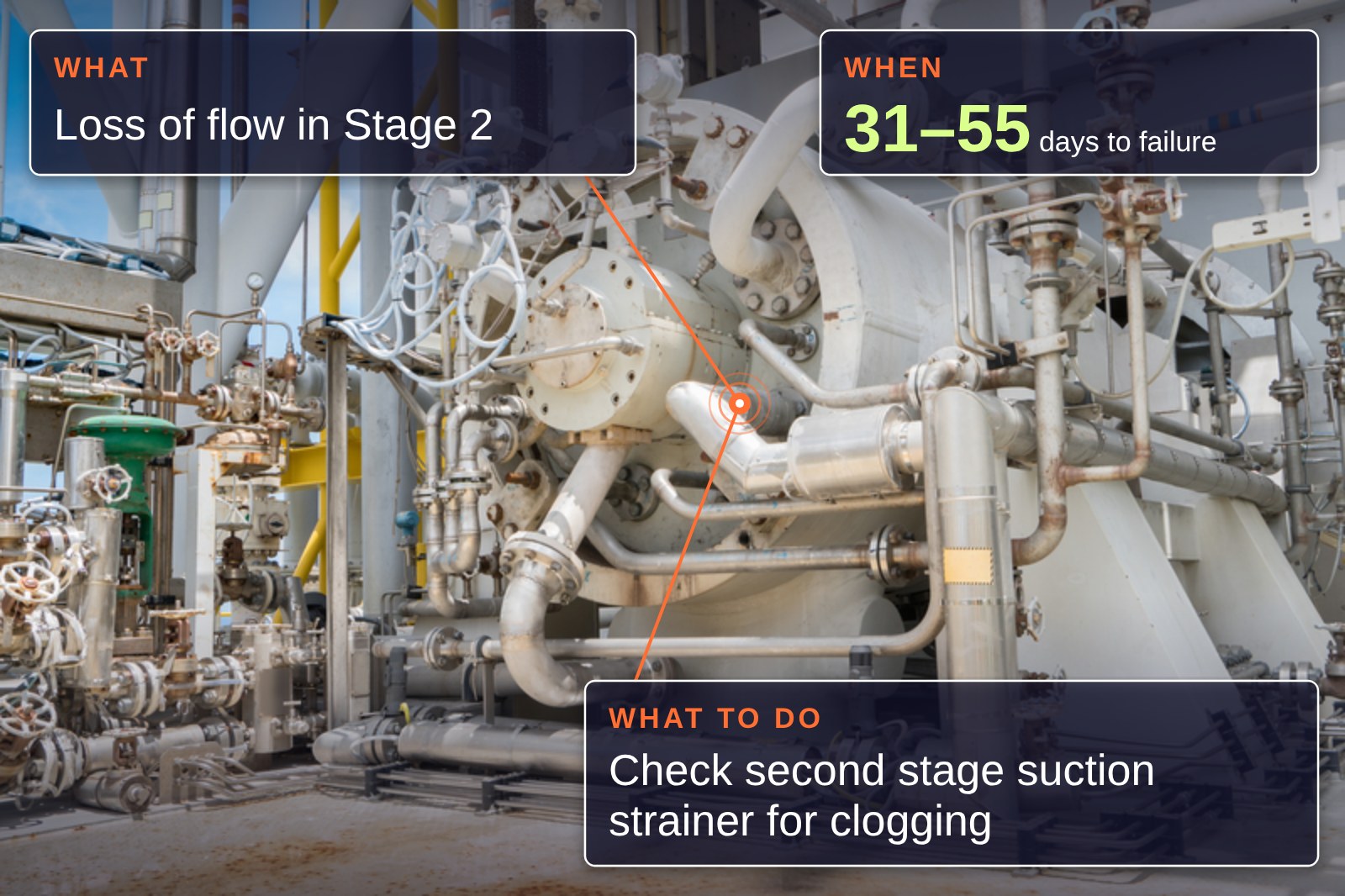
Four example high-impact fault modes from our compressor coverage.
Tracked against the expected operating map.
Polytropic efficiency degrades as internal clearances open up and seals wear. TruPrognostics AI tracks per-stage efficiency against operating point and produces a remaining useful life forecast at every tier.
Detected before mechanical damage.
One of the most common precursors to centrifugal compressor failure. Catchable in the process domain at Base; resolved with frequency-domain precision at Plus and Premium. Remaining useful life forecast at every tier.
Diagnosed from process data alone.
Worn or damaged seals let gas recirculate from the high-pressure side to the low-pressure side, reducing effective stage work. The signature shows up as a specific pattern of efficiency loss on the affected stage.
A precursor to bearing failure, diagnosed precisely.
Sub-synchronous vibration patterns characteristic of fluid-film bearings approaching their stability limit. Diagnosed with frequency-domain analytics on raw vibration waveforms at the Plus and Premium tiers.
Process data first. Vibration where it earns it.
Centrifugal compressors are well suited to process-domain analytics. The relationships between pressures, temperatures, flows, and stage performance are well understood, and your historian already has the data.
TruPrognostics AI starts there. Detected anomalies are diagnosed against a library of fault-specific models, each calibrated to the physics of how the failure mode shows up in process variables. Where the data permits, the system also produces a remaining useful life forecast.
Each diagnosis ships with a recommended action, drawn from OEM manuals, customer SOPs and FMECAs, and prior work-order history. Every recommendation cites the source it draws from. Engineers keep decision authority; TruPrognostics AI does the analytical heavy lifting.
For mechanical and bearing-specific faults that don't surface cleanly in process data, a single high-frequency vibration sensor unlocks the frequency-domain analytics. One sensor, substantial diagnostic uplift.
See the full architecture →Day-one value at Base. Mechanical precision at Plus and Premium.
PI / historian process data. Stage efficiency, compression ratios, hydraulic performance. Catches efficiency loss, seal degradation patterns, and broad bearing decline.
Add one high-frequency vibration sensor on the bearing housing. Resolves bearing wear, oil whirl and whip, and mechanical signatures to fault-specific diagnoses.
Multiple high-frequency sensors. Maximum diagnostic precision on the most critical assets in your fleet.
See it on your own centrifugal compressors.
Send us a slice of your historian data. We return a working analysis on your assets in four weeks: written report, live walkthrough, and a platform with your data loaded.