
Centrifugal pump monitoring with a recommended next step.
TruPrognostics AI diagnoses cavitation, bearing wear, and other pump faults, forecasts remaining useful life, and recommends a specific maintenance action, citing the source it drew from.
Not ready to share data? Talk to us →
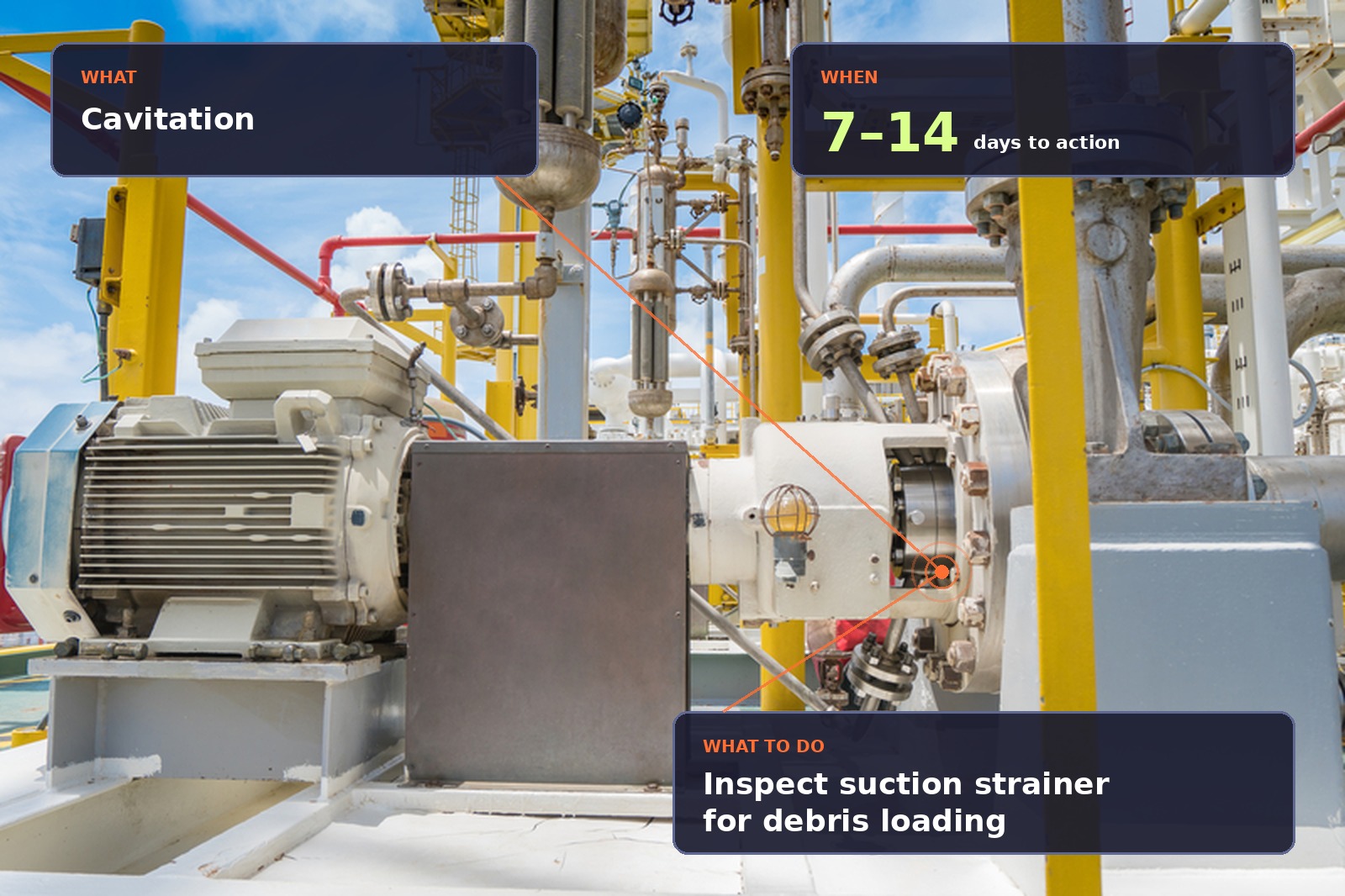
Four high-impact pump fault modes that TruPrognostics helps you predict.
TruPrognostics can detect up to 20 fault modes for centrifugal pumps. Reach out to us for the full list.
Detected from process data before it turns destructive.
Cavitation often starts incipient and is hard to see in any single signal. TruPrognostics AI uses a physics-based model fitted to flow, speed, and suction and discharge pressure to surface the signature early, giving teams time to clear the upstream restriction before impeller damage compounds.
Pump efficiency degradation diagnosed from head, flow, and power.
Worn impellers, recirculation, and internal clearance growth shift the pump's characteristic curve. TruPrognostics AI tracks the deviation from expected head-flow-power performance and isolates pump-side degradation from upstream process changes.
Bearing decline resolved to a specific fault mode.
Bearing wear surfaces as gradual shifts in vibration, motor current, and temperature long before catastrophic damage. A single high-frequency vibration sensor resolves it to inner race, outer race, cage, or rolling-element faults, with remaining useful life where data permits.
Diagnosed before leakage becomes a safety or environmental event.
Mechanical seal wear and partial failure show up in vibration, flow, pressure, and seal-flush behavior. TruPrognostics AI flags the developing pattern and ties it to a recommended inspection action.
Validated against real pump fault events.
True positive rate for cavitation detection on centrifugal pumps, validated against customer-confirmed events.
Detected from common process control data (flow, speed, suction and discharge pressure), with enough lead time to act before impeller damage compounds.
Process data first. Vibration where it earns it.
Centrifugal pumps are well covered by process-domain analytics. Suction and discharge pressures, flow, motor current, and speed already carry most of the signal for cavitation, impeller wear, seal degradation, and broad bearing decline. Your historian already has the data.
TruPrognostics AI often starts there. Detected anomalies are diagnosed against a library of fault-specific models, each calibrated to the physics of how the failure mode shows up in process variables. Where the data permits, the system produces a remaining useful life forecast.
Each diagnosis ships with a recommended action, drawn from OEM manuals, customer SOPs and FMECAs, and prior work-order history. Every recommendation cites the source it draws from. Engineers keep decision authority; TruPrognostics AI does the analytical heavy lifting.
For mechanical and bearing-specific faults a single vibration sensor unlocks frequency-domain analytics. Models run immediately on connection — no training period required. One sensor, substantial diagnostic uplift on the pumps where downtime cost dominates.
See the full architecture →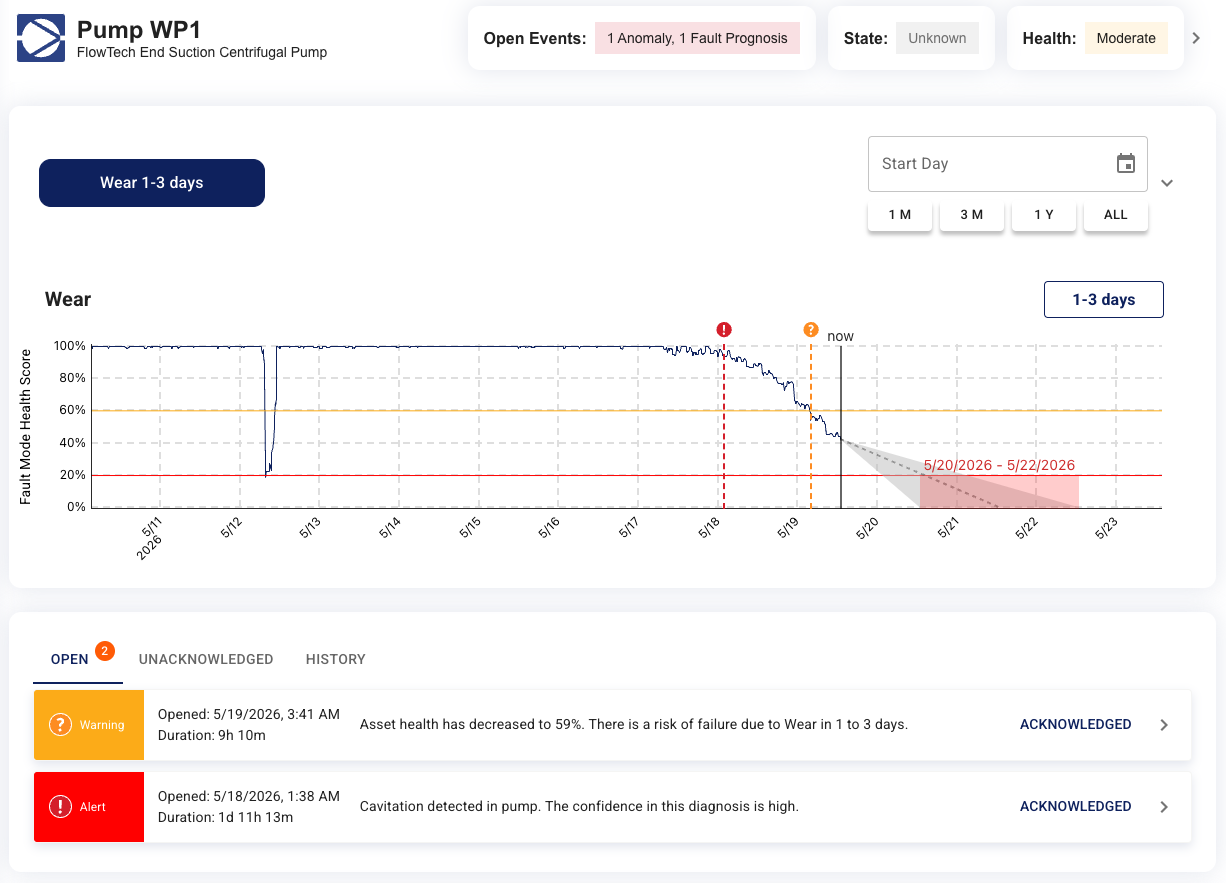
See it on your own centrifugal pumps.
Send us a slice of your historian data. We return a working analysis on your assets in four weeks: written report, live walkthrough, and a platform with your data loaded.