
Electric motor monitoring with a recommended next step.
TruPrognostics AI diagnoses bearing, winding, and eccentricity faults on AC induction motors, forecasts remaining useful life, and recommends a specific maintenance action, citing the source it drew from.
Not ready to share data? Talk to us →
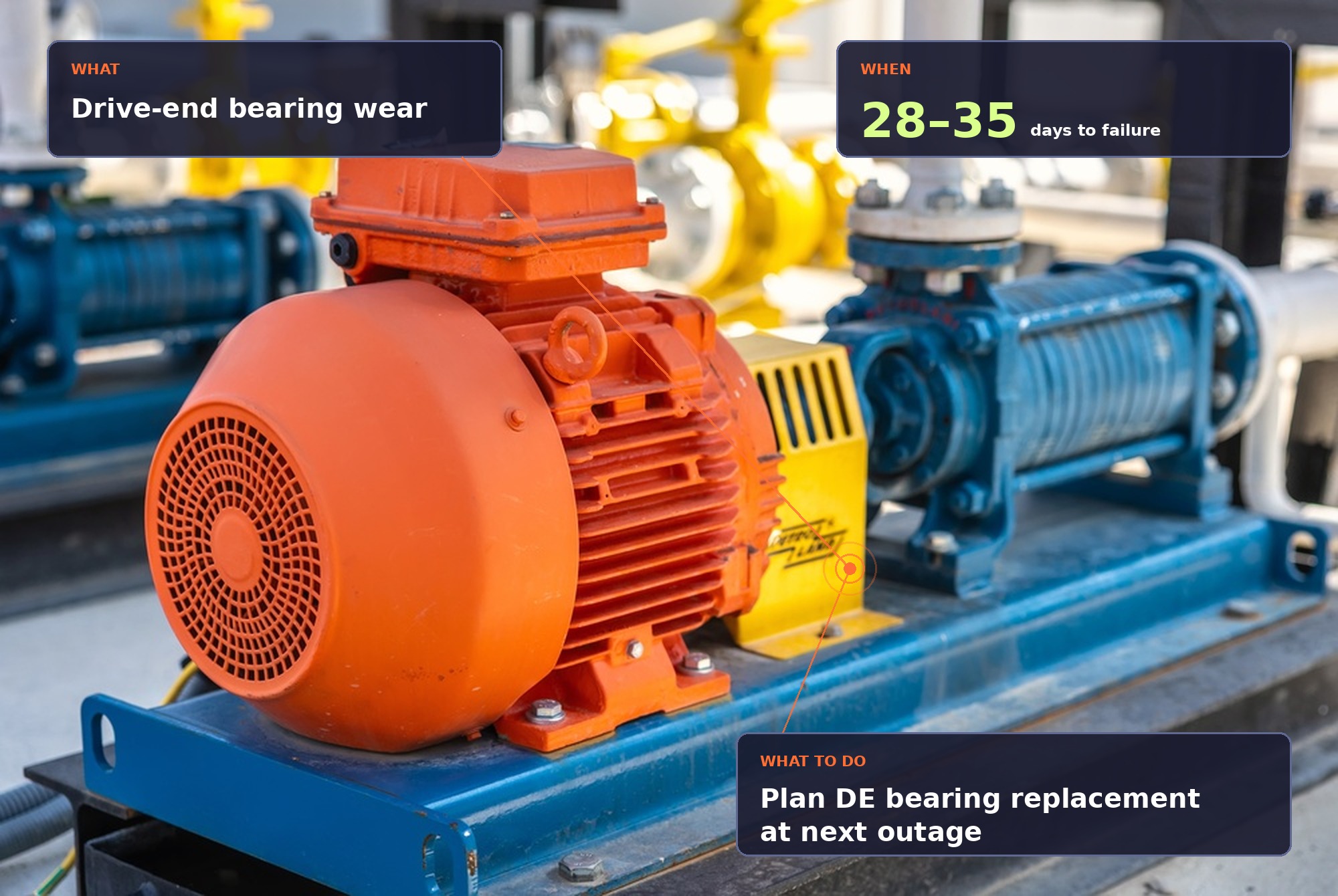
Four high-impact motor fault modes that TruPrognostics helps you predict.
TruPrognostics can detect up to 17 fault modes for electric motors. Reach out to us for the full list.
Resolved to a specific bearing fault, with RUL where data supports it.
Motor bearing wear surfaces in vibration overall, current, and temperature long before catastrophic damage. A single high-frequency vibration sensor resolves the signature to inner race, outer race, cage, or rolling-element faults, with a remaining useful life forecast where the data permits.
Stator and rotor electrical faults diagnosed from current signatures.
Broken bars, winding shorts, and insulation degradation produce characteristic current and vibration signatures. TruPrognostics AI flags the developing anomaly from electrical and process data, and pinpoints the specific fault when high-frequency vibration is available.
Air-gap and shaft misalignment diagnosed early.
Static and dynamic eccentricity stress windings and bearings and accelerate wear. The signature appears in vibration spectra at known harmonics of line and rotational frequency, where high-frequency vibration data is available.
Phase, voltage, and load imbalance flagged from current data.
Imbalances quietly increase thermal load and shorten motor life. TruPrognostics AI flags them from electrical measurements where the instrumentation supports it, giving teams time to correct course before damage compounds.
Validated against real motor fault events.
Fault detection accuracy across motor fault modes, validated against historical fault data at customer sites.
Coverage includes bearing, winding, eccentricity, and load-imbalance faults.
Motor bearing failure projected more than four weeks in advance.
A Fortune 500 oil and gas operator, offshore platform
On an offshore platform, a pump-driving motor equipped with a tri-axial accelerometer began showing the early signature of drive-end bearing wear. TruPrognostics AI projected the failure window more than four weeks out. As the fault progressed, the model narrowed the window to within a few days of the actual failure. Root cause: a loose drive belt accelerating bearing wear, an issue that wouldn't have been catchable from motor data alone.
Coverage tied to the driven asset, not bolted on to it.
Motors rarely fail in isolation. A loose drive belt accelerates motor bearing wear. A cavitating pump loads the motor harder. A failing winding shows up first as elevated temperature on the driven asset's process data. TruPrognostics AI monitors the motor as part of the train it drives, not as a standalone box.
Detected anomalies are diagnosed against a library of fault-specific motor models, each calibrated to the physics of how the failure mode shows up in electrical, vibration, and process data. Where the data permits, the system produces a remaining useful life forecast.
Each diagnosis ships with a recommended action, drawn from OEM manuals, customer SOPs and FMECAs, and prior work-order history. Every recommendation cites the source it draws from. Engineers keep decision authority; TruPrognostics AI does the analytical heavy lifting.
For bearing, winding, and eccentricity faults that need frequency-domain resolution, a single high-frequency vibration sensor unlocks the targeted analytics. Models run immediately on connection — no training period required. One sensor, substantial diagnostic uplift on the motors driving your most critical equipment.
See the full architecture →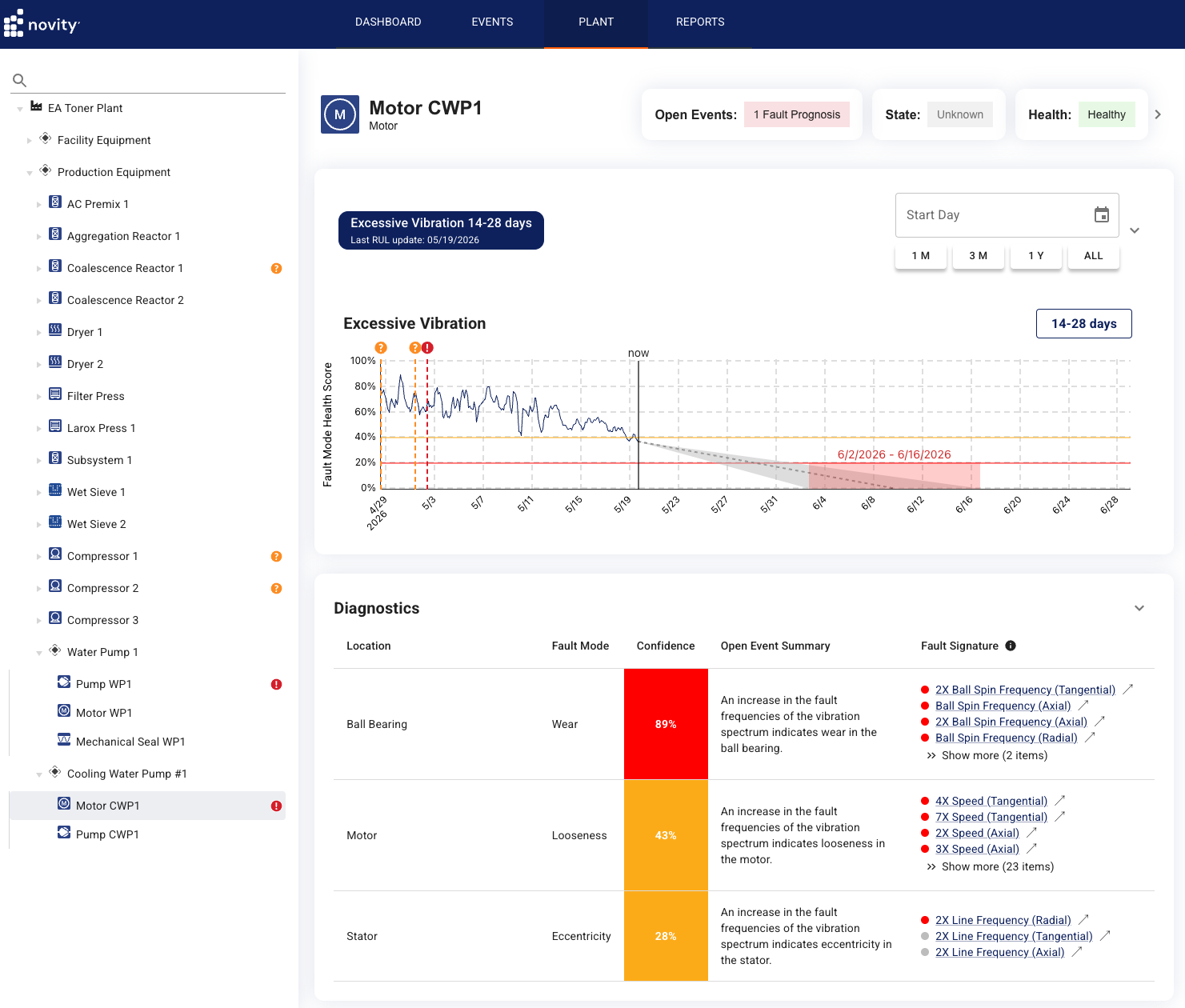
See it on your own motors.
Send us a slice of your historian or vibration data. We return a working analysis on your motors in four weeks: written report, live walkthrough, and a platform with your data loaded.
Want to Learn More?
Articles
The Hidden Cost of Equipment Failure in Wastewater Plants
PdM Insights
How Your Data Quality Prevents Truly Predictive Maintenance
Datasheets
AC Induction Motor Monitoring with TruPrognostics
PdM Insights
Proactive Fault Detection in Motors
White Paper
Are Your Predictive Analytics Truly Predictive?